Other Statues in the Church of St. Edward
From the earliest centuries of Christianity, sacred images have helped the faithful lift their minds and hearts to God. Statues, paintings, stained glass windows, and other works of sacred art are more than decoration; they are visual expressions of the Gospel that teach the faith, inspire prayer, and remind us of the communion of saints. They invite us to contemplate the mysteries of Christ's life, the example of the Blessed Virgin Mary and the saints, and the saving work of God throughout history.
The Church honors these sacred images not for the materials from which they are made, but for the holy persons and events they represent. They serve as windows into the mysteries of our faith, encouraging us to imitate the virtues they portray and to deepen our relationship with Jesus Christ. As you explore the artwork within our church, may these images draw your heart more fully into prayer and lead you ever closer to the Lord, whom they faithfully proclaim.
In the front of the Sanctuary, we are honored to have four statues. Here we will present them from the left to the right.
Our Lady of Perpetual Help
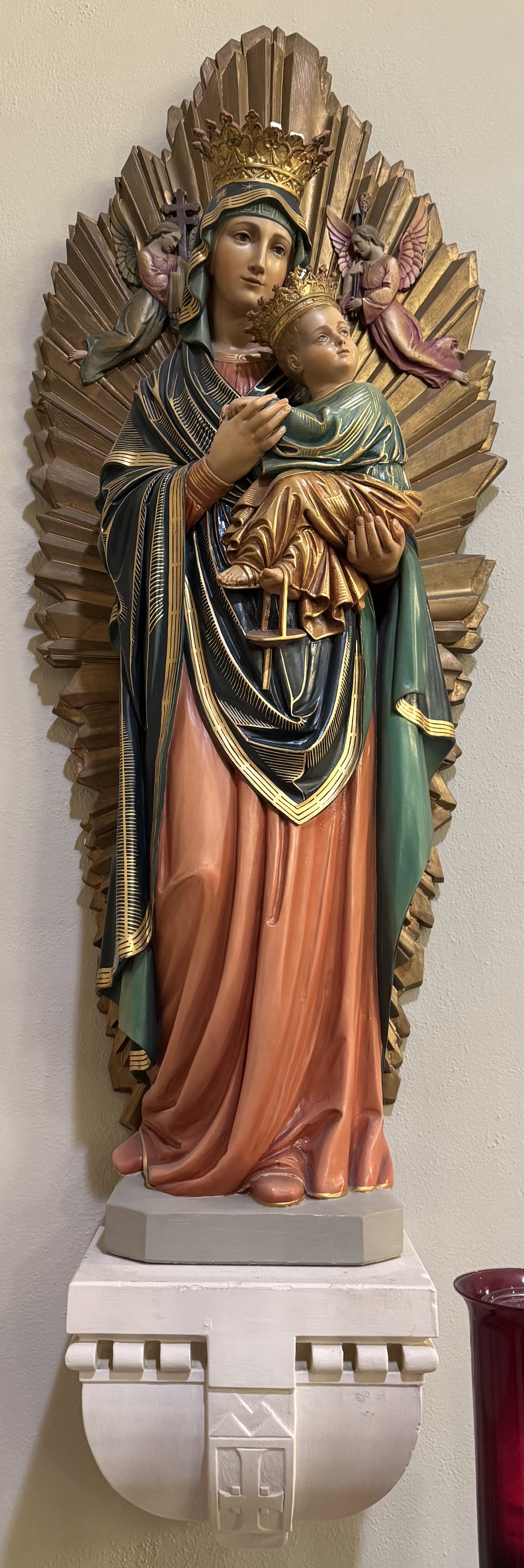
This statue depicts the beloved image of Our Lady of Perpetual Help, a 3D representation of the Blessed Virgin Mary holding the Christ Child in the midst of His Passion. The statue closely follows the traditional icon associated with the ancient image of Our Lady of Perpetual Help, traditionally venerated in Rome, where the Mother of God is shown as the loving protector who leads the faithful to trust in the saving mercy of her Son.
Mary stands before a radiant sunburst, symbolizing her holiness and her role as the Mother who reflects the light of Christ. She wears a deep blue outer garment with gold trim, a traditional symbol of her heavenly dignity and her unique participation in the mystery of salvation. Beneath it, her red garment recalls love and sacrifice, while her crowned head honors her as Queen of Heaven.
Mary holds the Christ Child on her left arm, while with her right hand she gently holds His hands, directing our attention not only to the Child but also to the mystery of His saving Passion. Her gesture reveals the tenderness of a mother who comforts her Son and invites all who approach her to place their trust in Him.
The Christ Child is shown wearing a turquoise-blue outer garment with gold accents and a golden undergarment, signifying His divine glory. He wears a crown as the eternal King, yet His expression reveals His awareness of the suffering that awaits Him. His head turns toward the angel carrying the spear and other instruments of the Passion, while His right sandal hangs loosely from His foot. This small detail is rich in meaning: in the presence of the vision of His suffering, Christ clings to His Mother, and she faithfully holds Him as He enters into the mystery of redemption.
On either side of Mary are two angels presenting symbols of Christ’s Passion. The angel on Mary’s right holds a two-barred cross, recalling the instrument of Christ’s death and His victory over sin. The angel on her left carries spears or arrows, recalling the suffering, rejection, and wounds that Christ would endure. These images remind us that the Child held in Mary’s arms is also the Savior who came to offer Himself for the salvation of the world.
The crowns placed upon Mary and Jesus proclaim their royal dignity and victory. Yet the image is not one of earthly power, but of love revealed through humility and sacrifice. Our Lady of Perpetual Help teaches us that Mary’s role is always to bring us closer to her Son, especially in moments of fear, suffering, and uncertainty.
Prayer to Our Lady of Perpetual Help
O Mother of Perpetual Help,
loving Mother of Jesus and our spiritual Mother,
look upon us with compassion and guide us always to your Son.
When we are burdened by fear, suffering, or uncertainty,
help us to place our hands in the hands of Christ
as you held His hands in yours.
Teach us to trust in the mercy of Jesus,
to remain faithful in times of trial,
and to follow Him with courage and hope.
Mary, Our Lady of Perpetual Help,
pray for us and lead us closer to the Heart of your Son.
Amen.
Donated by Mr. and Mrs. HJ Tillemans in 1943.
Blessed Mother and Christ Child
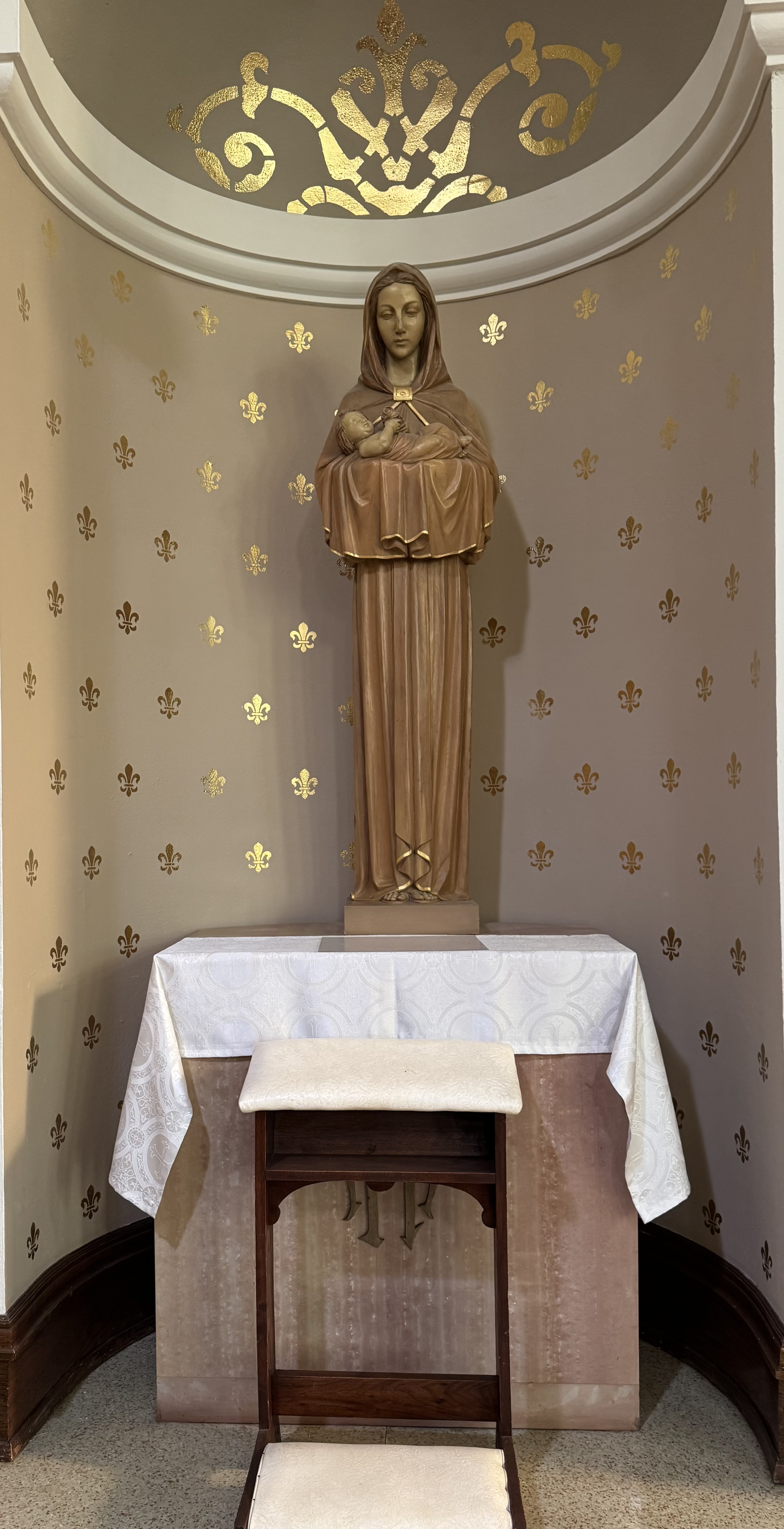
This wooden statue depicts the Blessed Virgin Mary tenderly holding the Christ Child, revealing the intimate bond between a mother and her Son and inviting us to contemplate the mystery of the Incarnation. Mary’s posture expresses both reverence and humility as she presents Jesus, not only as her beloved child, but as the Savior given to the world.
Mary’s arms and hands are covered with a cloth, a gesture that reflects the ancient Christian tradition of approaching holy things with reverence and honor. The covered hands recall the way sacred objects were handled in the liturgy and express Mary’s profound awareness that the Child she holds is not only her Son but the Son of God. Her humility points beyond herself and directs our hearts toward Christ.
The Christ Child holds a crumpled cloth in His hands, a small but meaningful detail that emphasizes His true humanity. The cloth may recall the simple signs of His earthly life—the vulnerability of an infant who depended completely upon Mary’s care. At the same time, it invites reflection on the mystery of Christ’s mission: the Son of God entered fully into our human condition, accepting humility, suffering, and ultimately the cloths of His burial after His saving Passion.
Together, Mary and the Child reveal the heart of the Gospel: God comes close to humanity. Through Mary’s loving embrace, we see the tenderness of God who chose to dwell among us, while the Child she carries reminds us that salvation comes through the humility and self-giving love of Christ.
Prayer to the Blessed Virgin Mary
Holy Mary, Mother of God,
you welcomed Jesus with faith, humility, and love.
Teach us to receive Christ into our hearts
with the same devotion and trust that you showed.
Help us to treasure the presence of your Son,
to follow Him with faithful hearts,
and to recognize God’s love in the humble moments of our lives.
Mary, Mother of Jesus and Mother of the Church,
pray for us and lead us closer to your Son.
Amen.
Donated by Mr. and Mrs. John Wambeke in 1952.
St. Joseph the Worker
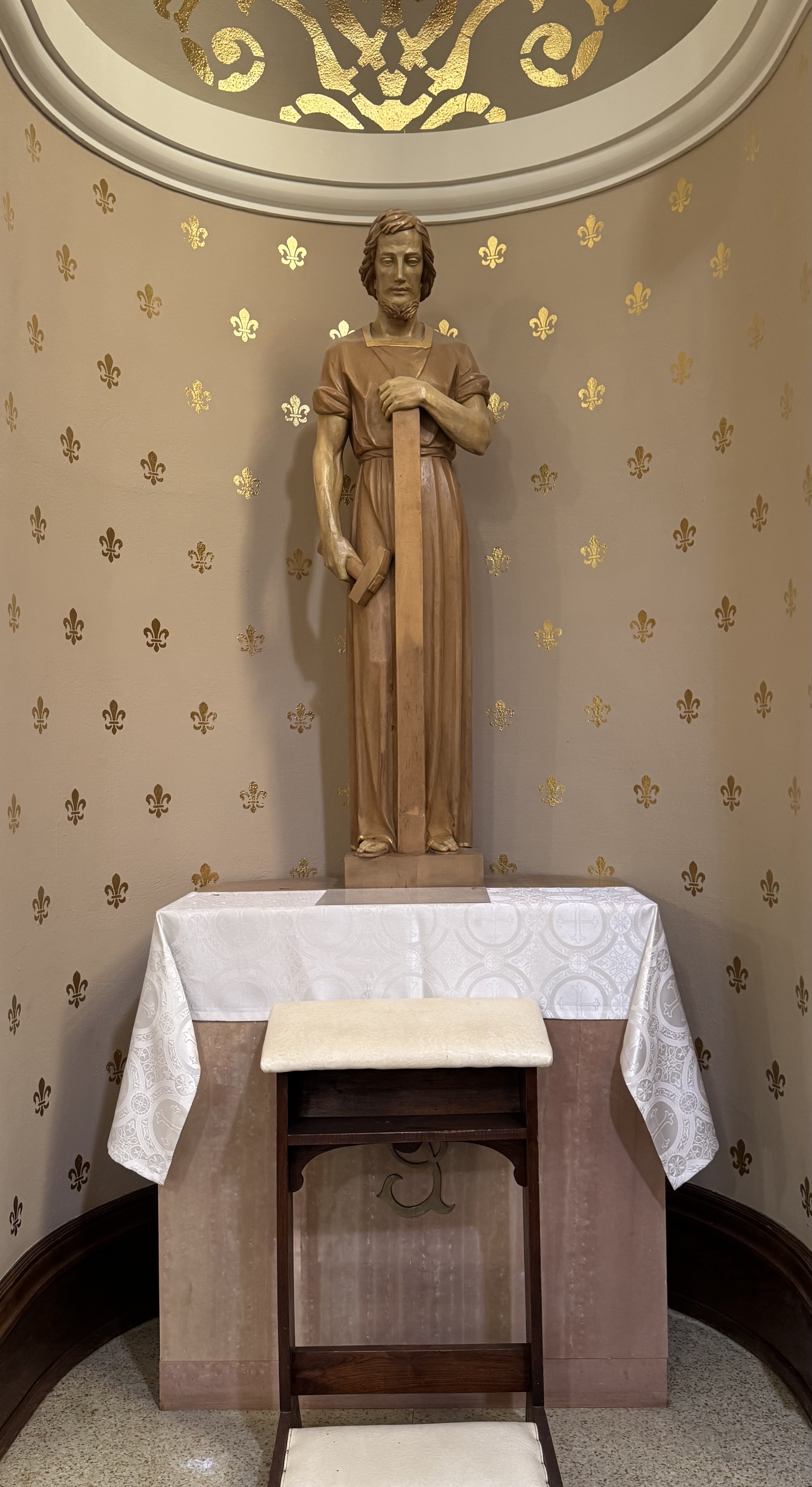
This wooden statue depicts Saint Joseph in his humble and noble role as the Worker of Nazareth, honoring the dignity of human labor and the holiness found in ordinary work. Unlike images of Saint Joseph holding the Child Jesus or the flowering staff associated with his purity, this depiction presents him as the carpenter who faithfully provided for the Holy Family through the work of his hands.
In his left hand, Saint Joseph holds a piece of lumber extending down to his feet, symbolizing his vocation as a carpenter and his willingness to serve God through daily labor. The wood also recalls the mystery of salvation: through Joseph’s faithful care for Jesus, the Son of God was raised in a home shaped by love, sacrifice, and honest work. The lumber points forward to the wood of the Cross, where Christ would accomplish the redemption of the world.
In his right hand, Joseph holds a hammer at his side, a simple tool that represents his craftsmanship, perseverance, and quiet strength. The hammer reminds us that Joseph’s holiness was lived not through public recognition, but through faithful service, responsibility, and humble dedication to those entrusted to his care.
Saint Joseph the Worker teaches us that every vocation and every honest task can become an offering to God. Through his example, we are reminded that work is not merely a means of providing for our needs, but an opportunity to participate in God’s creative work and to serve others with love.
Prayer to Saint Joseph the Worker
Saint Joseph the Worker,
faithful guardian of Jesus and husband of Mary,
pray for all who labor and strive each day.
Teach us to work with patience, humility, and love,
offering our daily tasks as a gift to God.
Help us to see dignity in every honest labor
and to use our gifts in service of our families, our communities, and the Church.
May your example of quiet faithfulness guide us
to place Christ at the center of all we do.
Saint Joseph the Worker,
pray for us.
Amen.
Donated by Mr. and Mrs. John Wambeke in 1952.
The Sacred Heart of Jesus
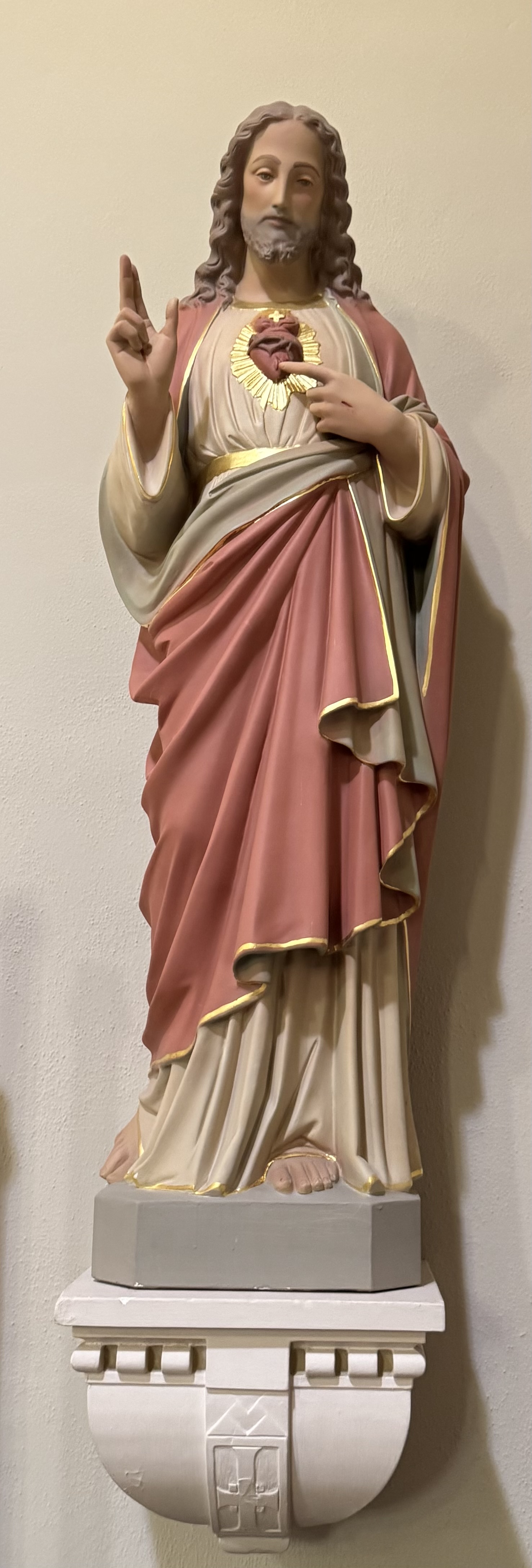
This statue depicts Jesus Christ revealing the mystery of His Sacred Heart, the visible sign of His boundless love and mercy for humanity. His right hand is raised in blessing, with two fingers extended in the traditional Christian gesture that recalls His divine and human nature and His role as the source of grace and blessing. His left hand directs our attention to His exposed Sacred Heart, inviting us to contemplate the love that moved Him to offer Himself completely for our salvation.
The Heart of Jesus is surrounded by a crown of thorns, recalling His Passion and the suffering He willingly endured out of love for the world. The flames rising from the Heart symbolize the burning charity of Christ—a love that cannot be extinguished and that continues to call every person to conversion, healing, and communion with Him. The red outer garment surrounding Christ represents His sacrificial love and the blood He shed for the redemption of humanity.
The Sacred Heart devotion reminds us that God’s love is not distant or abstract; it is a personal love revealed in the pierced Heart of Jesus. From that Heart flows mercy, forgiveness, and the invitation to trust in Him completely.
Prayer to the Sacred Heart of Jesus
Sacred Heart of Jesus,
source of divine love and mercy,
we place our trust in You.
Teach us to receive Your love,
to forgive as You forgive,
and to offer our hearts more completely to You.
May Your Heart, wounded for our sake and burning with love for us,
transform our lives and make us instruments of Your mercy.
Sacred Heart of Jesus,
have mercy on us.
Amen.
Donated by Mrs. William Boulton in 1943
The Crucified Lord
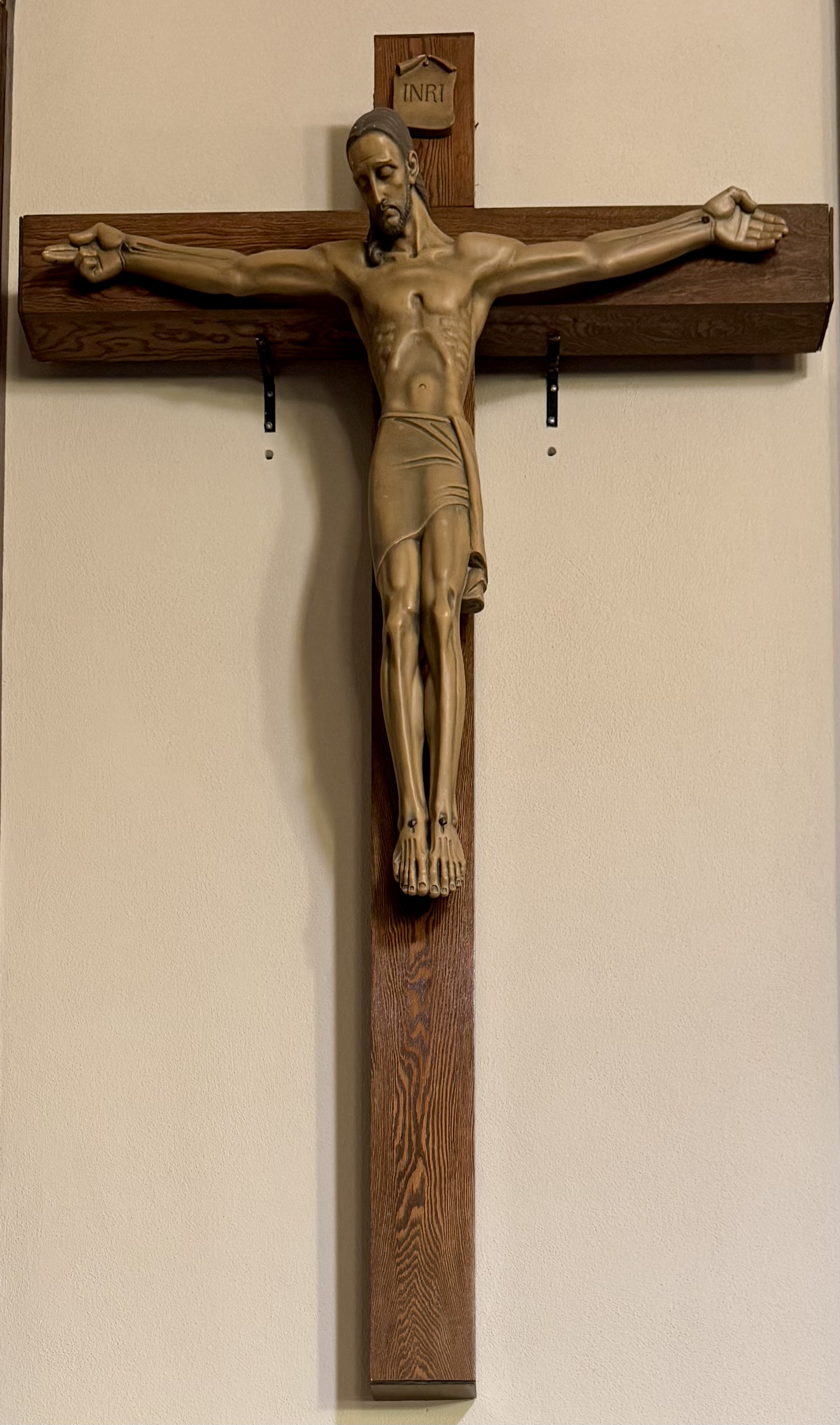
This wooden statue depicts Jesus Christ crucified upon the Cross, the supreme sign of God’s love and the source of salvation for the world. Mounted upon a dark wooden cross, Christ is shown in the moment of His ultimate self-offering, embracing suffering and death out of love for humanity. Above His head is the traditional INRI inscription, an abbreviation of the Latin words Iesus Nazarenus Rex Iudaeorum—“Jesus of Nazareth, King of the Jews”—the title placed above Him at the time of His crucifixion.
The nails are placed through His wrists, a detail that reflects the physical reality of the suffering Christ endured. His outstretched arms reveal the depth of His love: the Savior reaches out to embrace all people and draws humanity back into communion with the Father. The wood of the Cross, once an instrument of suffering and death, has become for Christians the tree of life and the sign of victory over sin and death.
A striking feature of this statue is Christ’s right hand, which remains in a gesture of blessing. With the pointer and middle fingers extended, He offers a blessing even in the midst of His Passion. This gesture reminds us that the Cross is not merely an image of suffering, but the revelation of divine mercy. From the Cross, Jesus continues to bless, forgive, and pour out His grace upon the world.
The crucified Lord invites us to contemplate a love that holds nothing back. His wounds reveal the price of our redemption, while His blessing reveals the heart of God—a heart that responds to human sin and suffering with forgiveness, mercy, and self-giving love.
Prayer Before the Crucified Lord
Lord Jesus Christ,
as I gaze upon Your Cross,
help me to understand the depth of Your love for me.
You stretched out Your arms to embrace the world
and offered Your life for our salvation.
Teach me to unite my sufferings with Yours,
to forgive as You forgave,
and to trust always in Your mercy.
May Your wounded hands bless and strengthen me,
and may the Cross that brought us salvation
guide me closer to Your Sacred Heart.
Jesus, crucified and risen Lord,
have mercy on us.
Amen.
This Crucifix hangs above the elevator in the back of the sanctuary. It was installed in the front of the sanctuary in 1952 after the original stained glass windowswere removed. It appears to be very similar to the wood statues of the Blessed Mother and St. Joseph, having been purchased around the same time.
Infant of Prague
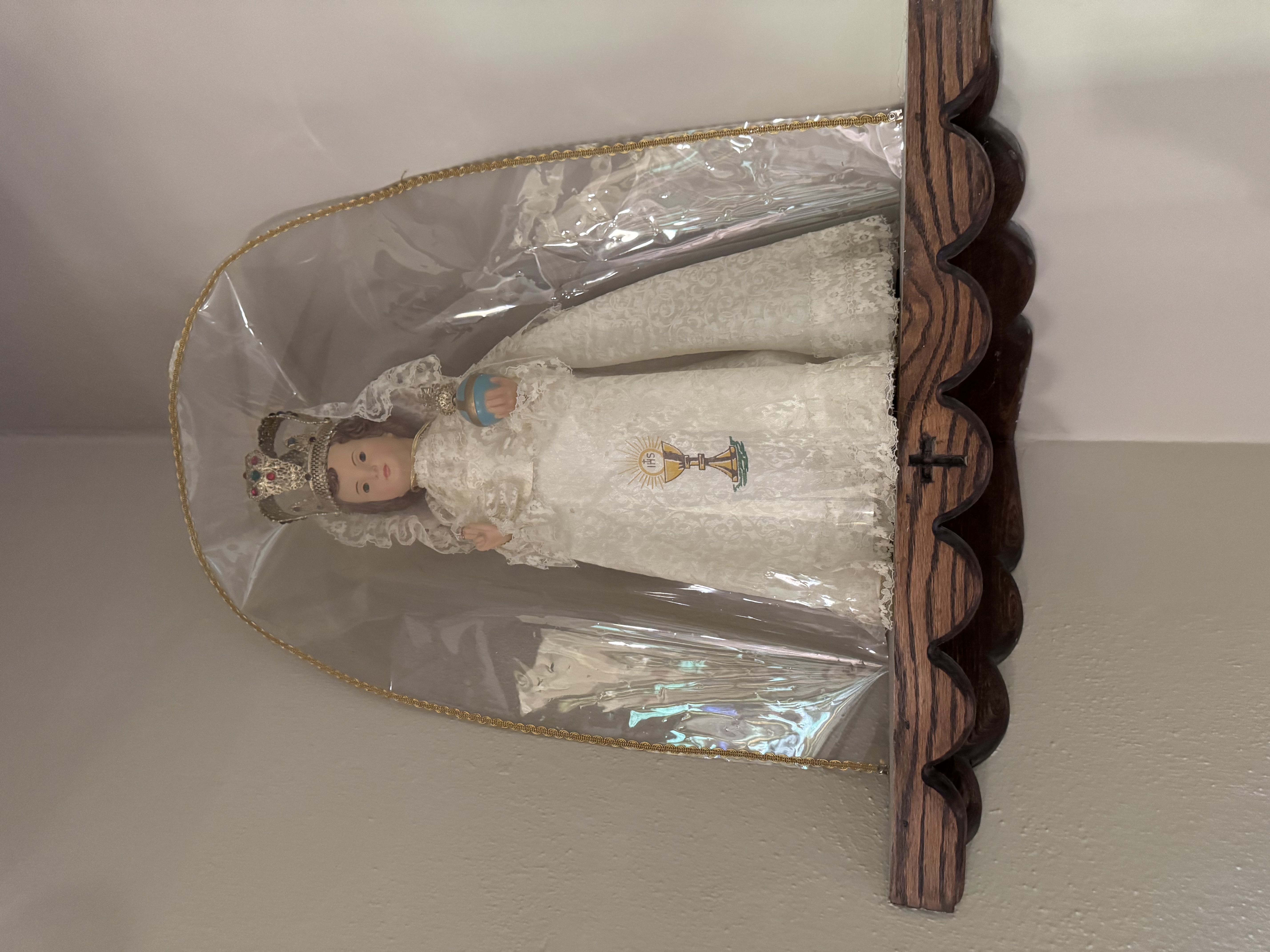
This statue depicts the beloved image of the Infant Jesus of Prague, presenting the mystery of the Son of God who became a child for the salvation of the world. Though shown in the appearance of an infant, Jesus is portrayed with the dignity and authority of a king, reminding us that the Child of Bethlehem is also the eternal King and Lord of creation.
The Christ Child stands in a traditional pose, with His right hand raised in blessing. The gesture expresses His divine authority and His desire to bestow grace upon all who approach Him with faith. The raised hand reminds us that even as a child, Jesus is the source of every blessing and the Savior who came to bring peace, mercy, and salvation to humanity.
In His left hand, the Infant Jesus holds an orb surmounted by a cross, a symbol of His dominion over the entire world. The orb represents creation itself, while the cross upon it reveals the manner in which Christ conquers—not through earthly power, but through the humble sacrifice of love. The image proclaims that the Child who rested in Mary’s arms is the King who reigns through mercy and self-giving love.
The royal appearance of the Infant Jesus, often shown with elaborate garments and a crown, expresses the Church’s faith that Christ is both fully human and fully divine. The richness of the clothing reflects His heavenly glory, while His childlike form reminds us of God’s humility in choosing to enter the world as a vulnerable infant.
The devotion to the Infant Jesus of Prague invites the faithful to approach Christ with the trust and simplicity of a child. It reminds us that God’s power is revealed not in worldly greatness, but in His closeness, tenderness, and love for His people.
Prayer to the Infant Jesus of Prague
O Infant Jesus of Prague,
King of heaven and earth,
look upon us with love and mercy.
Bless our families, our homes, and our hearts.
Teach us to trust in Your providence,
to surrender our fears to You,
and to welcome Your presence with the faith of a child.
May Your blessing remain with us always,
and may we grow ever closer to You,
who came among us in humility and love.
Infant Jesus of Prague,
have mercy on us.
Amen.
This statue is in the back of the sanctuary, on the left hand side as you face the main entrance, in the corner by the cry room above the ushers pew.
It was donated by Alvin and Eileen Differding in 1981 in honor of the centennial celebration.
Our Lady of Grace
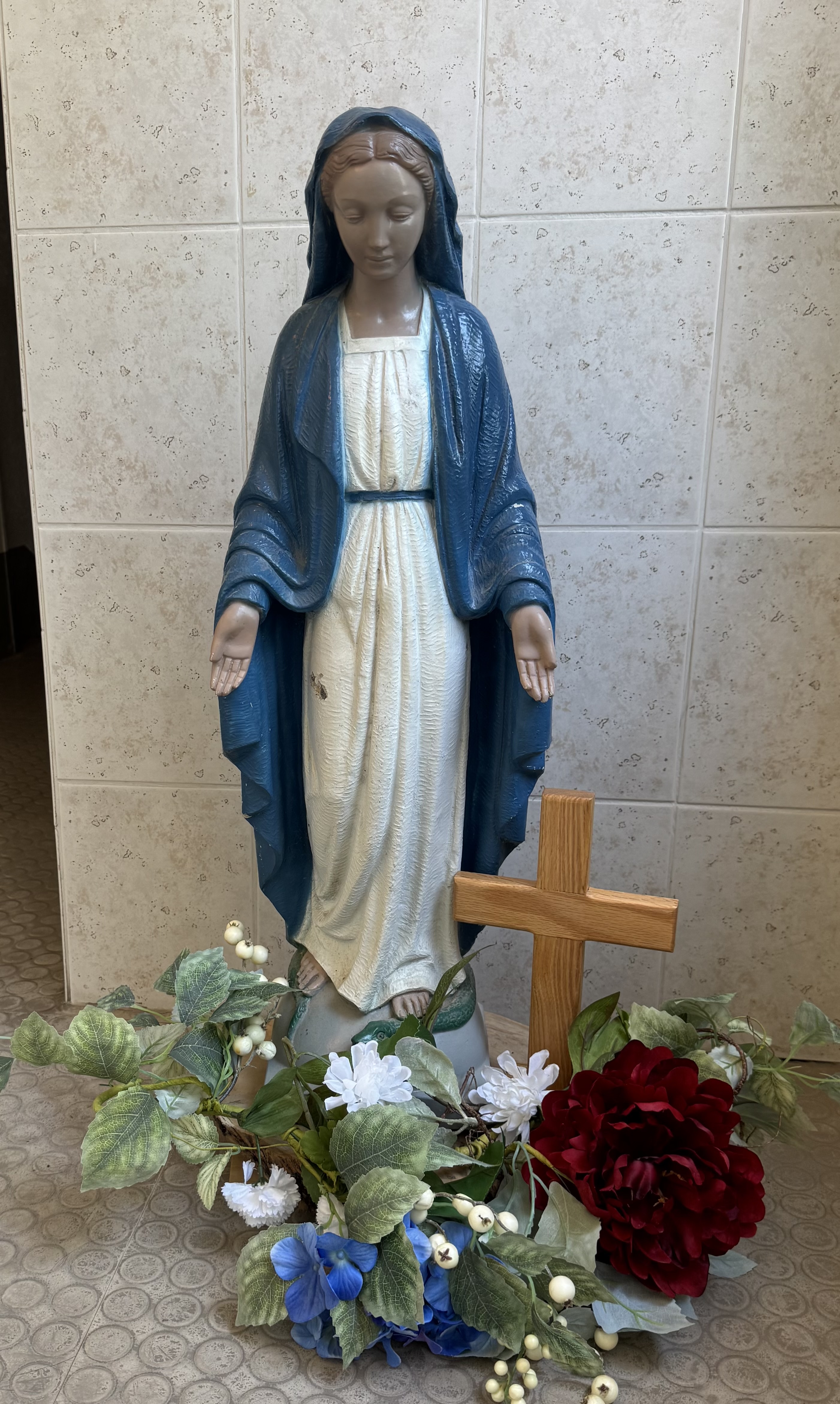
This statue depicts the Blessed Virgin Mary under the traditional title of Our Lady of Grace, reminding us of her loving role as the Mother of the Church and the first disciple of Christ. Clothed in a white gown and a blue mantle, Mary reflects the beauty of holiness and the purity of the Immaculate Conception. White symbolizes her freedom from sin through God's grace, while the blue mantle has long represented her heavenly dignity and fidelity to God's will.
Mary stands with her hands extended toward all who come before her. This welcoming gesture expresses her maternal love and her readiness to receive our prayers and present them to her Son. It also reminds us that every grace comes through Christ, and that Mary faithfully leads all who seek her intercession to Jesus.
Her serene expression invites us to imitate her virtues of humility, faith, and complete trust in God. At the Annunciation she answered the angel with her wholehearted "yes," and throughout her life she remained steadfast beneath the Cross and joyful at the Resurrection. As our spiritual Mother, she continues to accompany the Church, encouraging us to follow Christ with confidence and hope.
The statue reminds us that devotion to Mary is never an end in itself. Like the words spoken at the wedding feast of Cana, her message to every generation remains the same: "Do whatever he tells you" (John 2:5). Through her loving intercession, she always leads us more deeply into the mystery of her Son.
Prayer to Our Lady of Grace
Blessed Virgin Mary,
Mother of God and our loving Mother,
receive us beneath your mantle of protection.
Teach us to imitate your faith,
your humility, and your complete trust in God's will.
Lead us always to your Son, Jesus Christ,
and help us to follow Him with generous hearts.
Pray for our families, our parish, and all who seek your intercession.
May we always grow in holiness
and one day rejoice with you in the glory of heaven.
Holy Mary, Mother of God,
pray for us.
Amen.
This statue is in the elevator entry of the church or on the stairwell to the basement as it moves with the seasons.
It appears to be mid-20th-century American concrete composition,(often produced between the 1940s and 1960s) by companies such as Daprato Statuary, F. Marti, or one of several Chicago or St. Louis ecclesiastical art studios. It bears an inscription that it was made in Canada. It has the classic "Our Lady of Grace" styling that became very common in American Catholic churches during that period.
Other Artwork In The Church
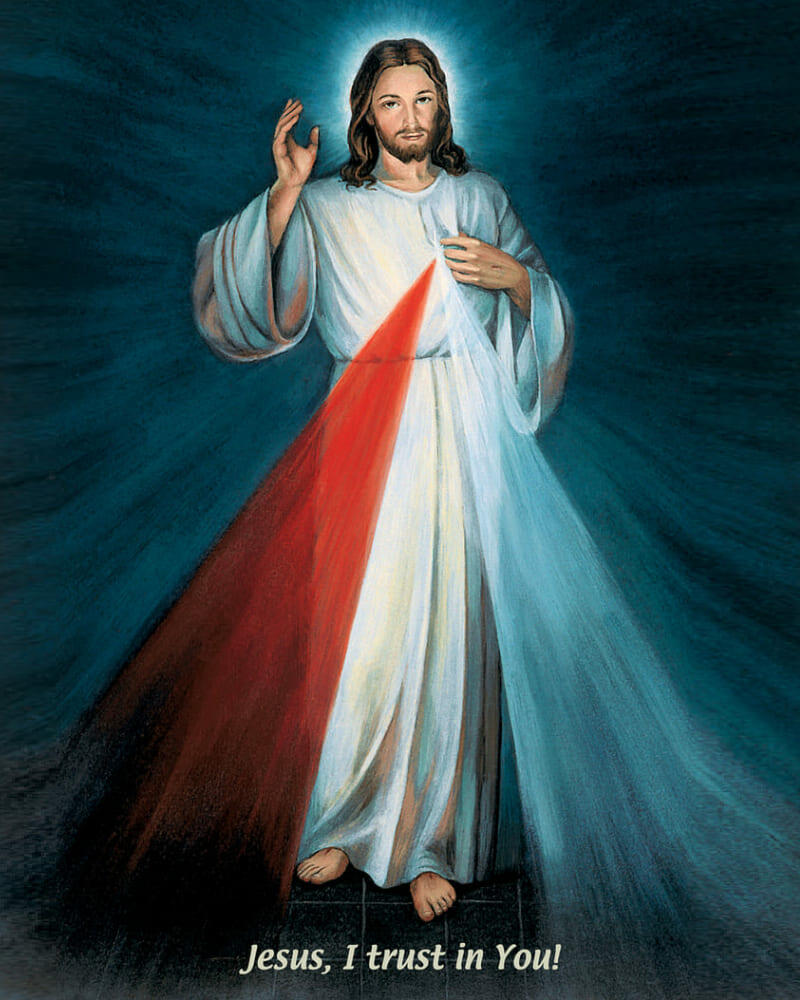
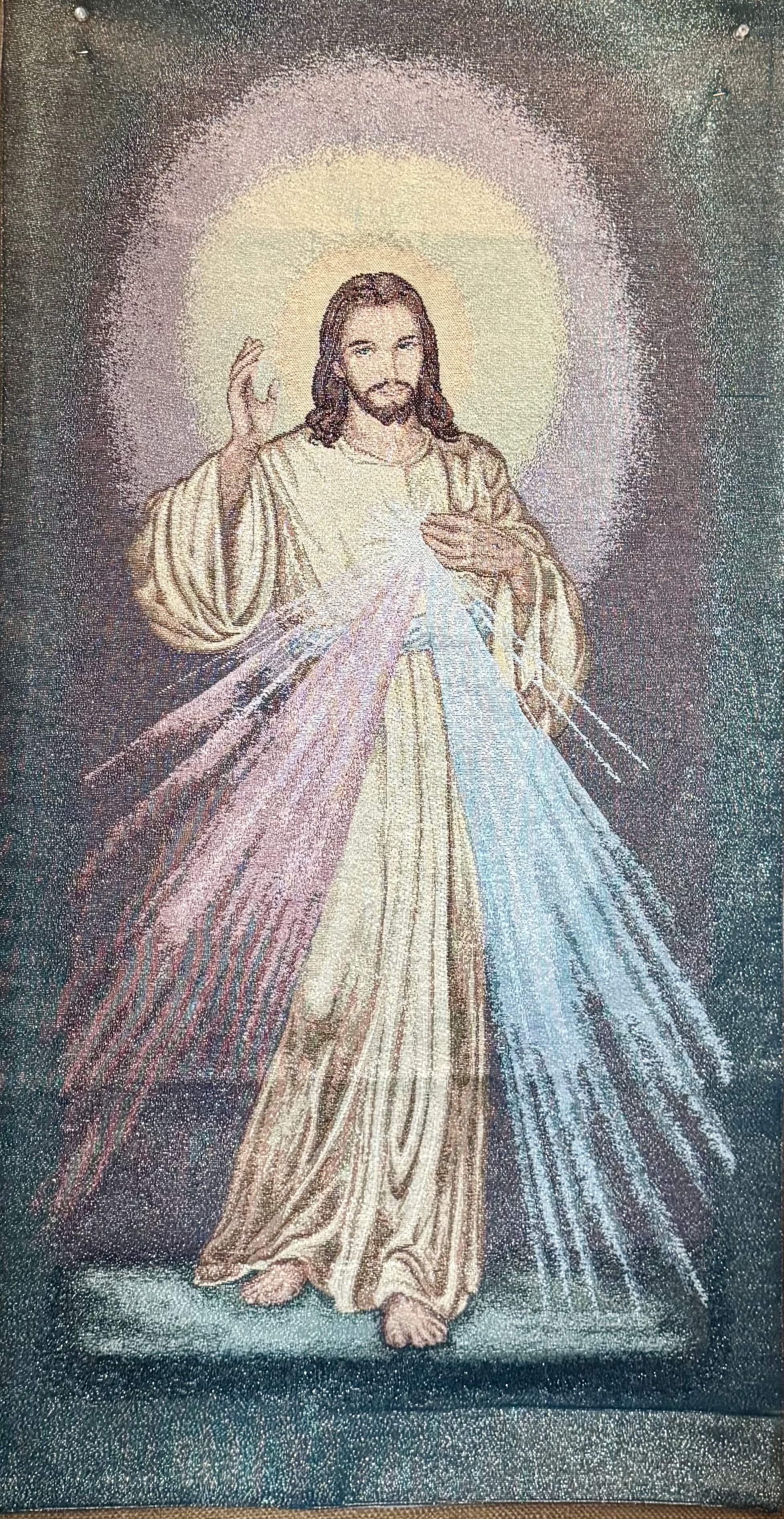
The Divine Mercy
This artwork depicts the Divine Mercy of Jesus according to the celebrated image painted by Adolf Hyła and associated with the message of mercy entrusted to Faustina Kowalska. The image presents the risen Christ approaching humanity with love, compassion, and the promise of His unfailing mercy.
Jesus stands with His right hand raised in blessing, extending forgiveness and peace to all who turn toward Him. His left hand opens His garment at His Heart, revealing rays of red and pale light flowing outward. These rays symbolize the blood and water that poured forth from His pierced side on the Cross—the blood representing the life of Christ given for the salvation of the world and the water representing the grace of baptism and the mercy that cleanses and renews souls.
The white garment of the risen Lord recalls His victory over sin and death and His glorified body after the Resurrection. Yet the visible wounds in His hands and the gentle gesture of His blessing remind us that the risen Christ is the same Jesus who suffered and died for us. His mercy is not an abstract idea, but a love revealed through His Passion and made present through His risen life.
In the Hyła version of the image, Jesus walks toward the viewer, emphasizing that divine mercy is not distant. Christ comes to meet each person where they are, offering forgiveness, healing, and hope. His peaceful expression and open posture reveal the heart of a Savior who desires not condemnation, but reconciliation and a return to friendship with God.
The words traditionally associated with the image—“Jesus, I trust in You”—express the central message of Divine Mercy: that the greatest response to God’s love is trust. The image invites every person to approach Christ with confidence, knowing that His mercy is greater than our sins and that His Heart remains open to all who seek Him.
Prayer to the Divine Mercy of Jesus
O Merciful Jesus,
You revealed Your Heart as a fountain of mercy and love.
Help me to trust in You completely
and to place all my fears, failures, and burdens into Your hands.
Pour out Your mercy upon me and upon the whole world.
Heal what is wounded within me,
forgive what separates me from You,
and transform my heart to become an instrument of Your mercy.
May I always remember that Your love is greater than my weakness
and that Your mercy triumphs over sin and death.
Jesus, I trust in You.
Amen.
This image is in the back of the sanctuary on the right hand side by the elevator. It was donated by Francis and Grace Rabaey in 2021.
Our Lady of the Prairie
This artwork depicts Our Lady of the Prairie (Click here for a full explanation), the patronal image of the Diocese of New Ulm, commissioned in 2025 to express Mary's maternal care for the faithful and her constant mission of leading all people to her Son, Jesus Christ. Inspired by the rich tradition of sacred iconography, the image weaves together Scripture, Catholic theology, and the history and landscape of southern Minnesota into a single visual catechesis. Bishop Zielinski commissioned Damien Walker to create this image.
Mary is clothed in radiant white as the Immaculate Conception and stands as a beacon of hope before the darkness of sin and despair. She holds the Christ Child, who raises His right hand in blessing while holding the Gospel in His left, proclaiming Him as the Word made flesh. Her gaze gently directs the viewer away from herself and toward Christ, reminding us that Mary's vocation is always to lead souls to her Son.
The artwork is filled with symbols of the Church's life and mission. Wheat represents both the Twelve Apostles and the Eucharist, while Mary's flowing robe symbolizes the river of sacramental grace reaching churches, homes, fields, and the people of the diocese. Images of Saint Peter's Basilica, the Cathedral of Saint Paul, the Cathedral of the Holy Trinity, the Mississippi River, and the prairie landscape express the continuity of the Catholic faith from Rome to Minnesota. Native American beadwork and other cultural elements honor the region's heritage while proclaiming the Gospel's fulfillment in Christ.
Our Lady of the Prairie invites all who contemplate this image to place their hope in Christ through the intercession of His Mother. As she presents Jesus to the world, she reminds us that the Church's mission is to proclaim the Gospel, celebrate the Eucharist, and bring the grace of Christ to every home and every generation.
Prayer to Our Lady of the Prairie
Our Lady of the Prairie, our Mother,
come to the aid of your children.
You of whom it was proclaimed by Elizabeth,
"Blessed is the fruit of your womb!"
make our hearts now fertile ground for the Holy Spirit
to bring Divine Life through us to every soul in our diocese.
Reveal to us your loving face and motherly care
and lead us always to the Eucharistic Heart of your Son:
the wellspring of our hope and our food for our pilgrim journey.
Amen.
This Image was purchased by the Parish and was placed in the back of the Sanctuary over the ushers pew in 2025.

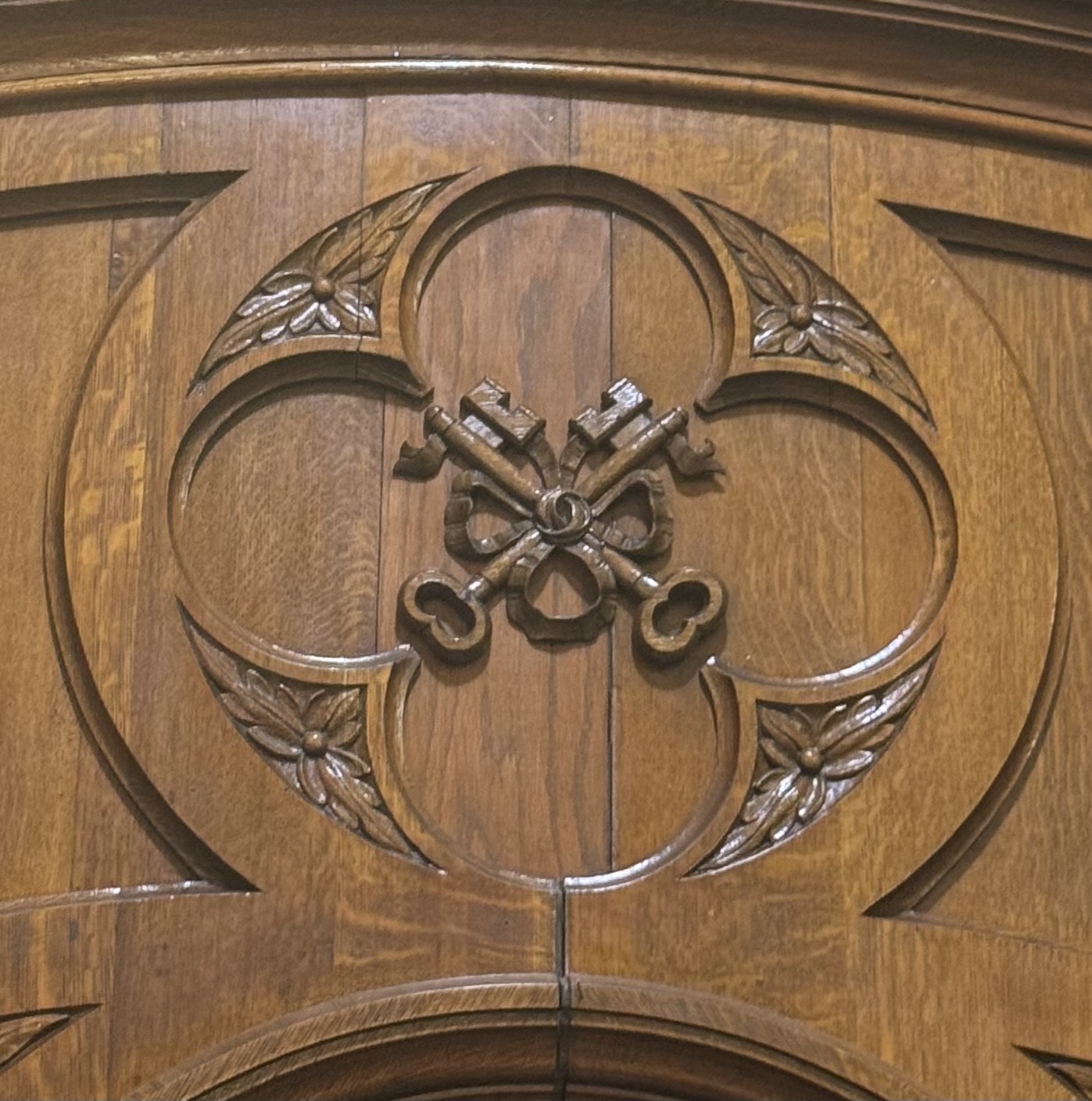
The Former Confessionals
This carved wooden panel once adorned the traditional confessionals that stood in the church's transepts. The confessionals were arranged in the classic design, with the priest seated in the center and penitents entering from either side, separated by a screen that allowed the Sacrament of Reconciliation to be celebrated with both privacy and reverence.
At the center of the carving are the crossed Keys of Saint Peter, the ancient emblem of the authority Christ entrusted to His Church. Jesus said to Peter, "I will give you the keys to the kingdom of heaven" (Matthew 16:19), and after His Resurrection He breathed upon the Apostles, giving them authority to forgive sins in His name (John 20:22–23). For this reason, the keys have long symbolized the Church's ministry of mercy exercised through the Sacrament of Reconciliation.
Surrounding the keys is a quatrefoil, a graceful four-lobed design commonly found in Gothic architecture. Its fourfold symmetry has traditionally recalled the four Gospels, through which the Good News of Christ's saving mercy is proclaimed to the ends of the earth. Together, these symbols beautifully expressed the purpose of the confessional: a place where sinners encounter the mercy of Christ through the ministry of His Church and are reconciled to God and one another.
The East Confessional was removed and in 1984, a side entrance was created from the space. The West confessionals are now used as a utility closet due to lack of space.
Sacred Images in the Confessional
The confessional is more than a place to confess sins; it is a sacred place of encounter with the mercy of Jesus Christ. Here the faithful come with repentant hearts, seeking forgiveness, healing, and reconciliation with God and His Church. The artwork within the confessional has been carefully chosen to foster prayer, inspire trust in God's mercy, and remind penitents that every confession is a personal encounter with the love of the Good Shepherd. Each image points to a different aspect of Christ's saving work and invites us to experience the peace that comes through the Sacrament of Reconciliation.
The Divine Mercy
The Divine Mercy tapestry presents the risen Christ extending His blessing while rays of red and pale light stream forth from His Sacred Heart. These rays recall the blood and water that flowed from His pierced side on the Cross, symbols of the sacraments through which His mercy is poured out upon the Church. The words, "Jesus, I trust in You,"summarize the heart of the Christian life and the disposition needed to receive God's forgiveness.
Within the confessional, this image reminds us that no sin is greater than God's mercy. Christ does not meet us with condemnation but with compassion, inviting us to trust in His love, confess our sins honestly, and receive the gift of reconciliation.
The Lost Sheep by Alfred Usher Soord
Purchased by the parish and placed in the confessional during the 2025 renovation, Alfred Usher Soord's beloved painting The Lost Sheep portrays Christ reaching out to rescue a lamb as predatory birds fly close by. Inspired by Jesus' parable of the Good Shepherd, the image illustrates the Lord's tireless search for every soul that has wandered from Him.
Few images are more fitting for a confessional. Every penitent who enters is like the lost sheep sought by the Shepherd who never ceases to love His flock. Rather than waiting for the sinner to return alone, Christ goes in search of the lost, lifts them up with tenderness, and rejoices when they are safely restored. The painting beautifully proclaims that every confession is a homecoming.
The Sacred Heart of Jesus
The statue of the Sacred Heart of Jesus reveals the Heart that burns with divine love for humanity. Crowned with thorns and aflame with charity, His Sacred Heart reminds us that Christ willingly accepted suffering to redeem the world. His raised hand offers a gesture of blessing while His exposed Heart invites all people to draw near with confidence.
Its presence within the confessional reminds us that forgiveness flows from the pierced Heart of Christ. The One who knows our sins also loves us without measure, welcoming every repentant sinner with mercy rather than judgment.
Donated by Henry and Alice Buysse in 1980.
Our Lady of Good Counsel
The image of Our Lady of Good Counsel depicts the Blessed Virgin Mary gently holding the Christ Child close to her cheek, expressing the intimate bond between Mother and Son. Throughout the centuries, Catholics have sought her intercession for wisdom, discernment, and guidance in following God's will.
Her presence within the confessional reminds us that Mary is also the Mother of Mercy, who lovingly accompanies her children on the path of conversion. She encourages us to examine our consciences honestly, to trust in God's forgiveness, and to follow her enduring counsel: "Do whatever He tells you" (John 2:5).
The Crucifix
Dominating the confessional is a large crucifix, the same crucifix carried in the church's Good Friday procession. It stands as the supreme reminder that every grace received in the Sacrament of Reconciliation was purchased by Christ's sacrifice upon the Cross.
As penitents confess their sins, they do so before the image of the crucified Savior, whose outstretched arms reveal the depth of God's love for the world. The Cross assures us that forgiveness is never cheap; it was won by the Precious Blood of Christ. At the same time, it proclaims the victory of divine mercy over sin and death, inviting every penitent to leave the confessional renewed in hope and restored to friendship with God.
Together these sacred images form a visual catechesis on the mercy of God. They remind us that the confessional is not a place of fear, but of grace—a place where the Good Shepherd seeks the lost, the Sacred Heart pours forth His love, the Blessed Mother intercedes for her children, and the Crucified and Risen Lord welcomes sinners home. Here the faithful encounter the inexhaustible mercy of Jesus Christ and experience anew the joy of forgiveness.